
USDC Payouts for Creators: Global Reach Meets the Local Cash-Out Reality
A major tech platform is paying creators in USDC worldwide, but local cash-out remains the real bottleneck.
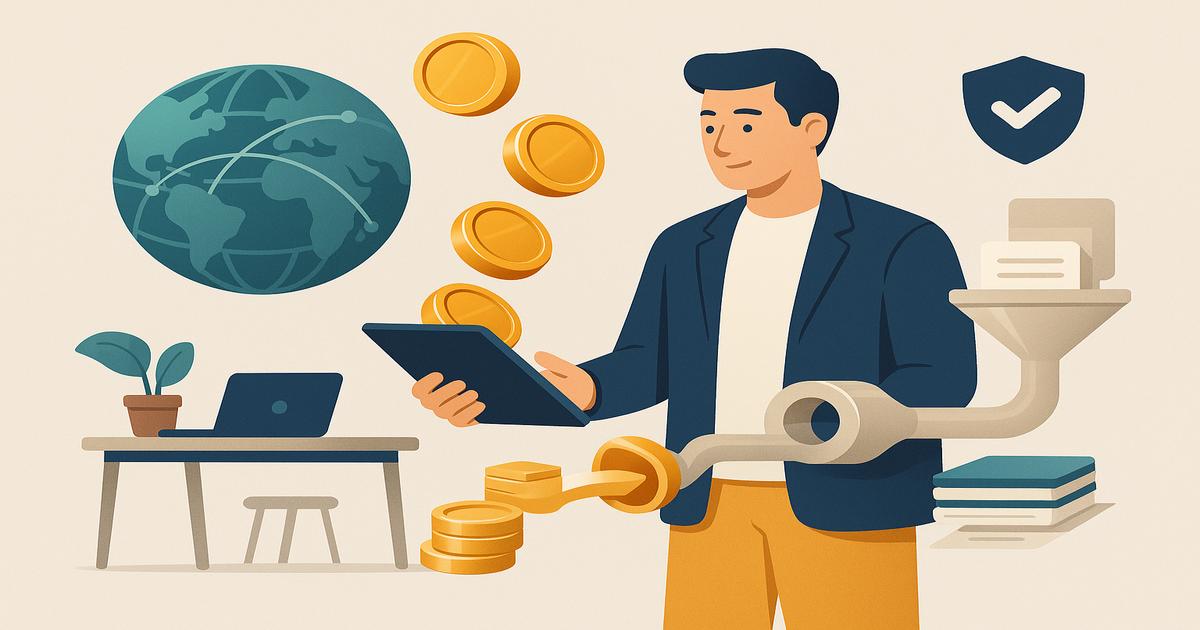
Stablecoins are steadily moving from a niche crypto tool to a practical payment rail for the digital economy. A notable signal of that shift is the decision by a large technology company to adopt USDC as a payout currency for creators. For influencers, educators, streamers, and independent publishers, this is more than a “crypto feature”: it is an attempt to modernize how cross-border income is delivered—at scale.
The initiative is designed for broad international coverage, reaching approximately 160 countries. That breadth matters because creator ecosystems are global by default: audiences can be anywhere, and so can the talent. Yet the actual value of a USDC payout is not determined solely by speed or network reach. It is determined by what happens next—namely, whether the recipient can reliably convert USDC into their local currency through compliant, accessible financial channels.
USDC Becomes a Creator Payment Currency
When a big tech platform chooses USDC for creator payouts, it effectively treats a stablecoin as a functional payment instrument rather than a speculative asset. USDC’s role here is straightforward: it serves as a standardized unit for distributing earnings to individuals who may be spread across dozens of banking systems, currencies, and payment norms.
For creators, receiving revenue in a stablecoin can reduce the friction associated with international transfers, intermediary banks, and legacy payout methods that were not built for small, frequent, cross-border payments. For platforms, it can streamline operations by unifying payout processes around a single digital settlement asset, instead of maintaining a complex matrix of local payment partners and currency conversion workflows.
A Global Footprint: Why “160 Countries” Is a Strategic Number
Coverage across roughly 160 countries is not just a marketing milestone; it is a strategic operating advantage. Creator economies thrive in regions where traditional payment rails are slow, costly, or inconsistent. By supporting stablecoin payouts at scale, a platform can reach creators in markets that were previously difficult to serve efficiently.
That said, “coverage” does not automatically equal “usability.” A creator in one jurisdiction might have multiple regulated ways to turn USDC into local currency, while another might have limited options, higher fees, or compliance hurdles. The global footprint is therefore an enabling layer—but not the complete solution.
The Operational Case for Stablecoin Payouts: Speed, Cost, Programmability
Stablecoin-based payouts bring three operational benefits that traditional systems struggle to match in combination:
- Speed: Digital settlement can reduce waiting times associated with multi-day transfer windows and manual reconciliation. For creators who rely on predictable cash flow, faster access to earnings can be meaningful.
- Lower operational cost: By reducing reliance on multiple intermediaries, stablecoin payouts can compress fee stacks. Even when conversion costs exist later, the distribution leg can still be more efficient than legacy alternatives.
- Programmability: Stablecoins can support automated payout logic. A platform can design rule-based disbursements—such as splitting revenue among collaborators, scheduling periodic payouts, or enforcing internal compliance checks—without rebuilding payment infrastructure country by country.
Consider a creator collective producing content with contributors in different countries. A programmable payout approach could distribute earnings instantly to each participant in USDC according to predefined shares, rather than requiring manual invoices and multiple cross-border transfers.
The Core Bottleneck: Converting USDC Into Local Currency
The central challenge is not receiving USDC—it is converting it into money that can be spent locally. This on/off-ramp step determines whether stablecoin payouts feel like a breakthrough or a burden.
Creators ultimately need to pay rent, taxes, vendors, and daily expenses in local currency. If converting USDC requires complicated steps, high spreads, limited liquidity, or uncertain timelines, the practical benefit declines sharply. Even when conversion is possible, costs may shift from the platform’s payout process to the creator’s personal cash-out process—changing who bears the friction rather than eliminating it.
In effect, stablecoin payouts solve the “global distribution” problem but can expose the “local access” problem. The experience varies dramatically based on local financial infrastructure and the availability of compliant service providers.
Regulated Infrastructure and Local Financial Access Still Decide Outcomes
Stablecoin payouts do not operate in a vacuum. They depend on regulated infrastructure and the recipient’s access to local financial services. This creates two layers of dependency:
1. Regulated gateways: Conversion typically relies on compliant entities that can bridge stablecoins and fiat currencies. Where such gateways are mature, creators can cash out more smoothly. Where they are limited, the stablecoin becomes harder to use as income. 2. Local financial inclusion: Even with compliant providers, creators may still need local accounts or services to complete the conversion and spend the proceeds. If access to banking or approved financial services is constrained, the advantages of a digital payout diminish.
This is why the long-term impact of USDC creator payouts will be shaped less by the stablecoin itself and more by the practical availability of trustworthy, regulated on/off-ramps in each market.
What This Signals for Fintech and the Creator Economy
A big tech platform adopting USDC for creator payments is an important step toward modern payment rails. The combination of broad country coverage and stablecoin efficiency points to a future where global payouts can be handled with fewer moving parts.
However, the real measure of success will be whether creators can reliably convert USDC into local currency through regulated channels. Until on/off-ramp accessibility is consistently strong, stablecoin payouts will remain a powerful distribution tool with uneven real-world usability—highly effective in some regions, constrained in others.
Do you have questions?
Write to us!
We are at your disposal to answer all your questions and schedule a free consultation.
QuickExchange™
Via A. Maspoli, 7
(Sassi Center)
Opening hours
Mon–Fri 08:30–19:00
1st / last Sat 08:00–12:00
Sunday Closed
Public holidays Closed
Via Colombera, 10
Opening hours
Mon–Fri 09:00–19:30
Saturday 08:00–16:00
Sunday Closed
Public holidays Closed
Via Pobiette, 2
(Stabile Taiana)
Opening hours
Mon–Fri 08:30–18:00
Saturday Closed
Sunday Closed
Public holidays Closed
OFFICE CLOSED
August 10-21
Charles Spurgeon