

The Rise of Wearables Designed to Defend Biometric Identity
Wearable anti-surveillance tools are emerging as public facial identification expands.
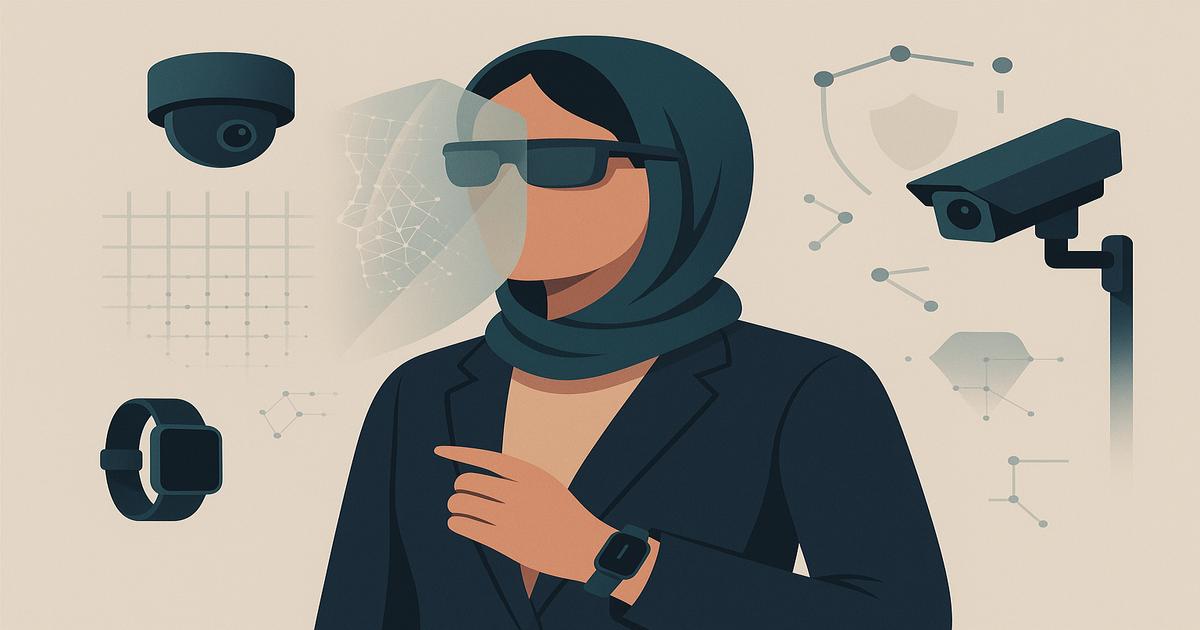
Automated identification is becoming part of the ordinary environment of modern cities. Cameras are no longer passive recording tools; in many settings, they are connected to systems capable of comparing faces, estimating identity and linking physical presence to digital profiles. As this capability spreads through public spaces, a new category of products is gaining attention: wearable devices built to reduce the reliability of facial recognition.
This is not simply a fashion trend or a niche technology experiment. It reflects a broader shift in how individuals think about identity. In a world where a face can function like a credential, protecting biometric data is becoming as important as protecting a password, a financial account or a private device.
Visual Designs as a Form of Digital Resistance
One of the most visible responses to automated facial identification is the use of patterns created to confuse recognition systems. These designs are not meant only to be decorative. Their purpose is to interfere with the way machines detect and interpret facial features.
Facial recognition systems typically depend on locating consistent reference points: the eyes, nose, mouth, jawline and the proportions between them. A carefully arranged visual pattern can make that process less reliable by drawing attention away from the actual face or by introducing signals that the system may interpret incorrectly.
For the wearer, the idea is straightforward: remain physically present without making biometric identification easy. The result is a new design language where clothing and accessories are evaluated not only by aesthetics, comfort or brand value, but also by their ability to challenge automated analysis.
Infrared Light Moves Into Everyday Wearables
Another important development is the integration of infrared light into items such as glasses, garments and textiles. Infrared is not generally visible to the human eye, but it can affect camera-based systems that rely on image capture. When embedded into wearable products, it can create interference around the face or body without necessarily changing how the person appears to others nearby.
Glasses are a natural starting point because they sit close to the key area most recognition systems attempt to analyze. Clothing and fabrics broaden the concept, turning the body itself into a surface capable of interacting with surveillance infrastructure. This moves anti-recognition technology away from isolated gadgets and toward everyday objects.
The significance of infrared-based wearables lies in their subtlety. Unlike overt visual signals, infrared systems may operate quietly in the background. They introduce a practical question for designers and users: can privacy protection become a built-in feature of ordinary apparel?
Biometric Privacy Becomes a Consumer Concern
The growing interest in these products points to a deeper change in public expectations. For years, digital privacy was mostly discussed in relation to online behavior: browsing, messaging, payments and data storage. Now, the same concern is extending into the physical world.
Biometric identity is different from other forms of personal information. A password can be changed. A card can be replaced. A face, however, is difficult to reset. Once facial data becomes part of an identification system, individuals may have little control over how it is used, shared or retained.
Wearables designed to protect biometric identity respond to this imbalance. They give individuals a tangible way to manage exposure in environments where identification may occur automatically. The appeal is not limited to people who want to avoid visibility altogether. Many users may simply want the ability to choose when and where their biometric traits are readable by machines.
Public Spaces Are Becoming Data-Rich Environments
The expansion of automatic identification in public areas is the force pushing this market forward. Streets, transport hubs, commercial districts and other shared spaces increasingly rely on camera networks and analytical systems. The more common these systems become, the more people begin to notice the lack of practical consent in physical surveillance.
This creates a new tension. Public spaces are open by nature, but automated identification can make them feel highly monitored. A person walking through a city may not know which systems are active, what data is being processed or whether their face is being compared against stored records.
Anti-surveillance wearables emerge from that uncertainty. They are a market response to an environment where identification is often invisible, continuous and difficult to challenge directly. Instead of depending only on policy or institutional restraint, these products offer a form of personal control at the level of the body.
A New Market Takes Shape
As demand grows, anti-surveillance devices are becoming a distinct product category. This market sits at the intersection of apparel, consumer electronics, privacy technology and personal security. Its products may include visually disruptive designs, infrared-enhanced accessories and fabrics engineered to reduce recognition accuracy.
The commercial opportunity is clear: if public identification systems continue to spread, tools that help people manage biometric exposure may become more mainstream. Early adopters may value experimentation and privacy activism, but wider adoption could come from ordinary consumers who simply view biometric protection as a normal part of personal safety.
The challenge for this market will be credibility. Products must do more than signal concern; they need to offer meaningful protection against real identification systems. At the same time, they must remain wearable, durable and socially acceptable. If anti-surveillance products are too uncomfortable or conspicuous, they may remain limited to a small audience.
Identity Protection Enters the Physical Layer
The emergence of anti-recognition wearables marks an important moment in the evolution of privacy. Identity protection is no longer confined to screens, accounts and encrypted services. It is moving into glasses, clothing and fabric.
As automated identification becomes more common in public life, the body itself becomes a point of interaction between the individual and the surveillance environment. That shift is creating both new risks and new forms of innovation.
The market for anti-surveillance devices is still developing, but its direction is already visible. People are beginning to treat biometric identity as something that deserves active protection. In that context, wearables are not just accessories. They are becoming tools for preserving personal autonomy in spaces increasingly shaped by machine vision.
Do you have questions?
Write to us!
We are at your disposal to answer all your questions and schedule a free consultation.
QuickExchange™
Via A. Maspoli, 7
(Sassi Center)
Opening hours
Mon–Fri 08:30–19:00
1st / last Sat 08:00–12:00
Sunday Closed
Public holidays Closed
Via Colombera, 10
Opening hours
Mon–Fri 09:00–19:30
Saturday 08:00–16:00
Sunday Closed
Public holidays Closed
Via Pobiette, 2
(Stabile Taiana)
Opening hours
Mon–Fri 08:30–18:00
Saturday Closed
Sunday Closed
Public holidays Closed
OFFICE CLOSED
August 10-21
Charles Spurgeon