

America’s Debt Burden Is Becoming a Market Risk
Rising debt costs could turn refinancing pressure into a broader test for markets.
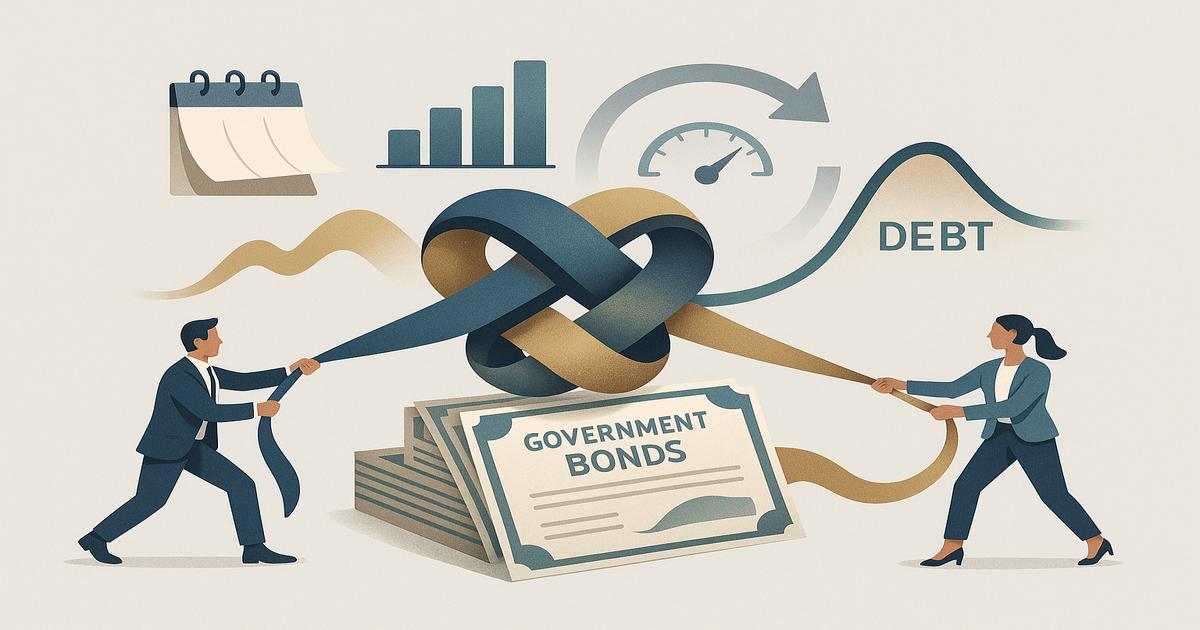
The debate over United States public finances is moving from a distant policy concern to a near-term market issue. The central question is no longer whether the federal debt is large, but whether the cost of carrying it could become difficult to absorb within the next three years.
A debt crisis does not usually arrive as a single dramatic event. More often, it develops through a series of pressures that gradually reduce flexibility. Interest payments consume a larger share of the budget. Maturing obligations must be replaced with new borrowing. Investors begin to demand greater compensation for risk. Each of these forces can be manageable in isolation. Together, they can create a dangerous feedback loop.
The Interest Bill Is the Pressure Point
The most important variable is the growing weight of interest payments on the federal budget. When borrowing costs are low, a government can carry a large debt stock with less immediate strain. But when the cost of capital rises, the same debt becomes more expensive to maintain.
This is where fiscal vulnerability begins to show. A government budget is not only shaped by spending priorities and tax revenue; it is also shaped by the price paid to finance past borrowing. As interest expenses rise, they compete with every other line item. The budget becomes less adaptable, and policymakers have fewer options to respond to shocks.
The issue is not simply accounting. Higher interest costs can change investor perception. Markets are highly sensitive to whether a borrower appears to be in control of its obligations. If interest payments keep rising faster than the budget can comfortably absorb, confidence can begin to weaken.
Refinancing Is Not a Technical Detail
A major source of risk comes from the need to refinance debt as it matures. Public debt is not paid back all at once. It is continually rolled over. When existing obligations reach maturity, new debt must be issued to replace them.
In stable conditions, this process attracts little attention. Investors buy the new debt, the government meets its obligations, and the system continues. But refinancing becomes more delicate when borrowing costs are higher. Debt that was issued under cheaper conditions may have to be replaced at a more expensive rate.
That transition matters. It means the budget can become progressively more exposed even without a sudden increase in the total debt stock. The pressure builds as older, cheaper liabilities are swapped for newer, costlier ones. Over a period of several years, this can significantly alter the fiscal picture.
Why the Next Three Years Matter
The risk horizon is especially important. A crisis within three years would not require an immediate collapse in demand for government debt. It could emerge through a slower repricing process, where investors become increasingly cautious and refinancing becomes more expensive.
The danger is that the budget may be forced to adjust to higher capital costs while still needing to issue large amounts of debt. In that environment, markets may begin to question whether fiscal management is sustainable without stronger measures.
A three-year window is short enough to matter for investors, banks, asset managers, and policymakers. It is also long enough for refinancing pressure and interest costs to compound. That combination makes the situation more than a theoretical concern.
Higher Capital Costs Expose Fiscal Weakness
The federal budget is most vulnerable when the cost of capital rises. Low rates can hide structural weaknesses because financing remains affordable. Higher rates do the opposite. They reveal how dependent the system has become on cheap borrowing.
This is similar to a company that can operate smoothly while credit is abundant, but suddenly faces difficult choices when lenders raise the price of financing. The underlying business may not change overnight, yet its financial resilience can deteriorate quickly if more cash must be directed toward debt service.
For a government, the implications are broader. A rising interest burden can reduce room for policy action, increase market scrutiny, and make every refinancing cycle more important. The higher the cost of capital, the smaller the margin for error.
The Systemic Market Dimension
The United States public debt market sits at the center of global finance. Any serious loss of confidence would not remain confined to budget discussions. It could influence pricing across financial markets, alter risk appetite, and force investors to reassess assumptions about safety and liquidity.
A systemic impact does not require outright default. Markets can become unstable simply because investors begin to demand higher compensation, reduce exposure, or question the reliability of existing valuations. Confidence is a financial asset in itself; once damaged, it can be difficult to rebuild quickly.
This is why the debt issue must be treated as a market stability question as well as a fiscal one. Rising interest costs, repeated refinancing needs, and sensitivity to capital costs form a connected risk structure. If that structure comes under stress, the consequences could extend well beyond the federal budget.
A Confidence Test for the Financial System
The coming years may serve as a test of investor trust in the fiscal capacity of the United States. The challenge is not merely the size of the debt, but the interaction between debt maturity, refinancing requirements, and the price of money.
If capital remains expensive, the budget will face increasing pressure. If refinancing becomes more difficult, markets may react sharply. If confidence erodes, the effects could spread through the financial system.
For investors, the key signal will be whether rising interest obligations remain manageable or begin to dominate the fiscal outlook. The difference between those two outcomes could define the next phase of market risk.
Do you have questions?
Write to us!
We are at your disposal to answer all your questions and schedule a free consultation.
QuickExchange™
Via A. Maspoli, 7
(Sassi Center)
Opening hours
Mon–Fri 08:30–19:00
1st / last Sat 08:00–12:00
Sunday Closed
Public holidays Closed
Via Colombera, 10
Opening hours
Mon–Fri 09:00–19:30
Saturday 08:00–16:00
Sunday Closed
Public holidays Closed
Via Pobiette, 2
(Stabile Taiana)
Opening hours
Mon–Fri 08:30–18:00
Saturday Closed
Sunday Closed
Public holidays Closed
OFFICE CLOSED
August 10-21
Charles Spurgeon