

U.S. Military Confirms Operation of a Bitcoin Node for Security and Cryptographic Testing
A U.S. military command has confirmed it runs a Bitcoin node to evaluate the network’s cryptographic backbone.
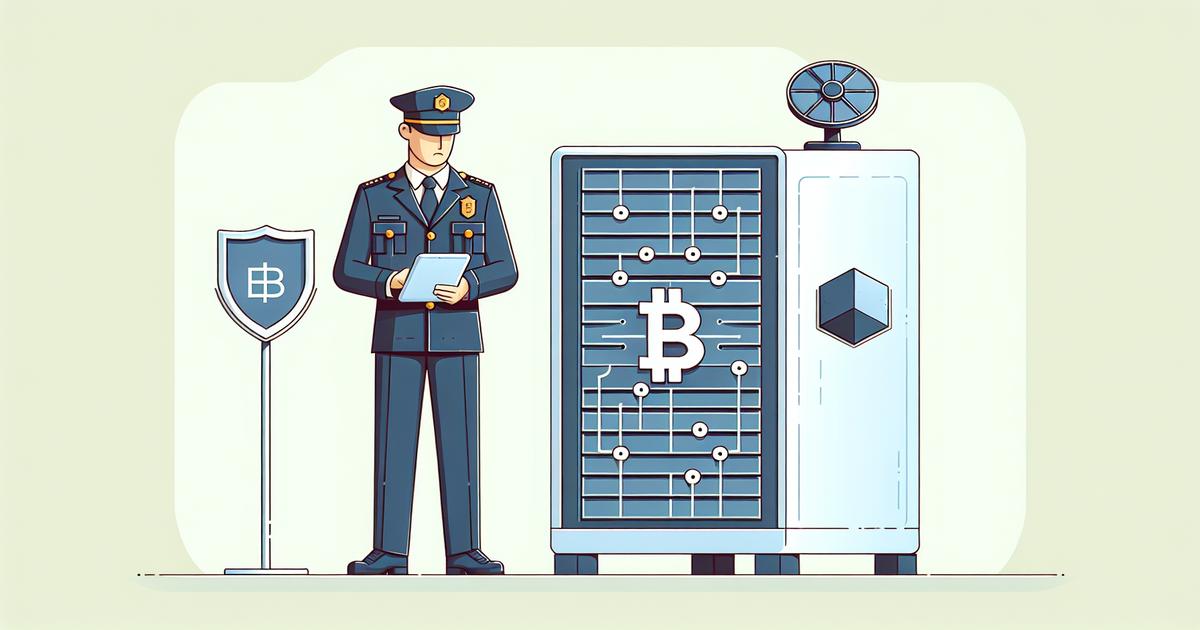
A Military-Run Node Enters the Bitcoin Network Picture
The U.S. armed forces are managing a node on the Bitcoin network, a detail that places a traditionally civilian financial infrastructure inside a formal defense-led testing context. While Bitcoin nodes are commonly operated by exchanges, universities, developers, and individual users, the presence of a node managed by a military organization is significant because it signals institutional interest in understanding the network’s behavior under real-world conditions.Running a node is not merely “observing Bitcoin.” It means participating in the verification process that keeps the network coherent: validating data, enforcing rules, and maintaining an independent copy of the ledger. For a defense organization, that operational posture can be useful for studying how a globally distributed system functions without centralized control—especially when evaluated through the lens of resilience and reliability.
Confirmation from INDOPACOM Leadership
The confirmation comes directly from the commander of U.S. Indo-Pacific Command (INDOPACOM), Admiral Paparo. This matters as much as the technical act itself. A statement from a regional combatant command’s leader frames the activity as more than an isolated technical hobby; it situates it within a structured environment where experimentation is deliberate and tied to broader objectives.In practical terms, leadership confirmation implies oversight, resourcing, and intent. It indicates the node operation is not accidental exposure to new technology but a planned activity aligned with a defined perimeter—one that includes technology experimentation and security.
Operational Testing on Bitcoin’s Infrastructure
Rather than limiting the effort to theoretical analysis, the initiative includes operational tests on Bitcoin’s network infrastructure. Operational testing suggests hands-on exercises: standing up systems, monitoring performance, validating behavior, and measuring outcomes in conditions that mirror live environments.For example, operating a node enables measurement of how quickly a system can synchronize with the network, how it handles data propagation, and how it reacts to changes across the network. Even without changing Bitcoin or controlling outcomes, a node operator can learn how the infrastructure behaves as a living system—one where reliability depends on many independent participants and where robustness emerges from distributed verification.
This kind of testing is particularly relevant to organizations that evaluate infrastructure not only for performance, but also for continuity under stress, predictability of behavior, and the presence of strong rule enforcement.
Why the Cryptographic Architecture Is Treated as “Critical”
A specific focus of the initiative is the network’s cryptographic architecture, described as “critical.” In Bitcoin, cryptography is not a feature layered on top; it is foundational to identity, authorization, and integrity. It is the mechanism that makes it possible to verify authenticity and ownership without relying on a central authority.Treating cryptographic architecture as critical reflects an emphasis on the components that determine whether a system can be trusted at scale. From a security standpoint, cryptography is where assumptions live: what must remain unforgeable, what must remain unpredictable, and what must remain verifiable by anyone. Studying this architecture in a real operational setting—via a live node—lets testers observe how cryptographic rules are enforced continuously, not just in a lab demonstration.
In an environment focused on security outcomes, “critical” also implies that understanding cryptographic foundations is essential to evaluating risk, including how dependent a system is on its underlying security primitives and how confidently it can be assessed.
Positioned Within Technology Experimentation and Security
This initiative sits squarely within a perimeter of technology experimentation and security. That positioning is important because it clarifies the motivation: not speculative finance, not endorsement, but structured evaluation. In other words, the node is a tool for exploration—an instrument to test how a widely used, decentralized infrastructure behaves and what lessons it offers for security-minded technologists.A helpful way to interpret this is to view the Bitcoin network as a large-scale, continuously operating system with strict verification rules. Running a node allows a defense organization to examine the real operational cadence of such a system, and to conduct tests that are meaningful precisely because they occur on active infrastructure rather than a controlled simulation.
As financial innovation and security concerns increasingly intersect, the decision to operate a Bitcoin node under a military framework underscores a broader point: critical evaluation of cryptographic systems is no longer confined to academia or private industry. In this case, it is being pursued as part of an explicit, security-oriented technology experimentation effort—confirmed at senior command level and executed through direct interaction with the Bitcoin network’s infrastructure.
Do you have questions?
Write to us!
We are at your disposal to answer all your questions and schedule a free consultation.
QuickExchange™
Via A. Maspoli, 7
(Sassi Center)
Opening hours
Mon–Fri 08:30–19:00
1st / last Sat 08:00–12:00
Sunday Closed
Public holidays Closed
Via Colombera, 10
Opening hours
Mon–Fri 09:00–19:30
Saturday 08:00–16:00
Sunday Closed
Public holidays Closed
Via Pobiette, 2
(Stabile Taiana)
Opening hours
Mon–Fri 08:30–18:00
Saturday Closed
Sunday Closed
Public holidays Closed
OFFICE CLOSED
August 10-21
John Kenneth Galbraith